African Lovebird
A fabulous Lovebird is actually considered one of 9 varieties belonging to the genus Agapornis (Greek: αγάπη agape 'love'; όρνις ornis 'bird'). They are really some sort of ethnical as well as loving small-scale parrot. Their particular identify comes from the actual parrots' sturdy, monogamous couple that connects for a very long period of time. In the wild Lovebirds stays home in compact flocks along with feeds benefits, fruit and vegetables, grasses, together with seed products. Just before mankind intervened, lovebirds simply existed within the exotic areas of Africa and Madagascar. There the particular parrots also go after seed products, fruit, berries, leaf buds, flowers, insects, and also larvae. Most of the food list is definitely diversified; also it depends upon the actual birds’ habitats.
Some species are kept as pets, and several color mutations were selectively bred in aviculture. Their average lifespan is 10 to 15 years.
8 species are native to the African continent, while the Grey-headed Lovebird is native to Madagascar.
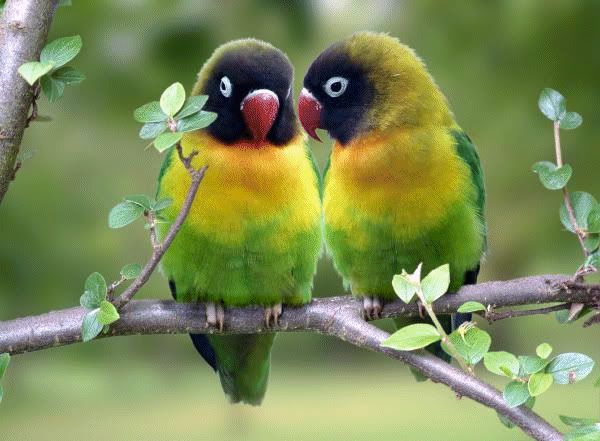
 Yellow-collared Lovebird
(aka: Masked Lovebirds)
Yellow-collared Lovebird
(aka: Masked Lovebirds)
* Agapornis Personatus
Description: 14 cm (5.5 in) Large.
Color in the wild: Yellow and green.
Has Blue tail feathers.
Color in captivity: Yellow, green, violet, mauve,
albino, blue, and pieds
Range: NE Tanzania
 Fischer’s Lovebird
*Agapornis Fischeri
Description: 14 cm (5.5 in) long.
Orange upper body and head.
Color in the wild: Green, blue lower
back and rump, red beak, white eyerings
Color in captivity: Yellow, green, violet,
mauve, albino, blue, pieds, and slate
Range: South and SE of Lake Victoria in northern Tanzania
 Lilian’s Lovebird
(aka: Nyasa Lovebirds)
*Agapornis Lilianae
Description: 13 cm (5 in) long.
Mostly green including green back and green rump, orange
head, red beak, white eyerings
Range: Malawi or Mallavi
 Black-cheeked Lovebird
*Agapornis Nigrinesis
Description: 14 cm (5.5 in) long.
Mostly green, brownish-black cheeks and throat, reddish-brown forehead and forecrown, orange upper chest, red beak, white eyerings
Color in the wild: Green
Color in captivity: Green, blue, violet, yellow, pieds,
and many upcoming transmutation.
Range: Zambia
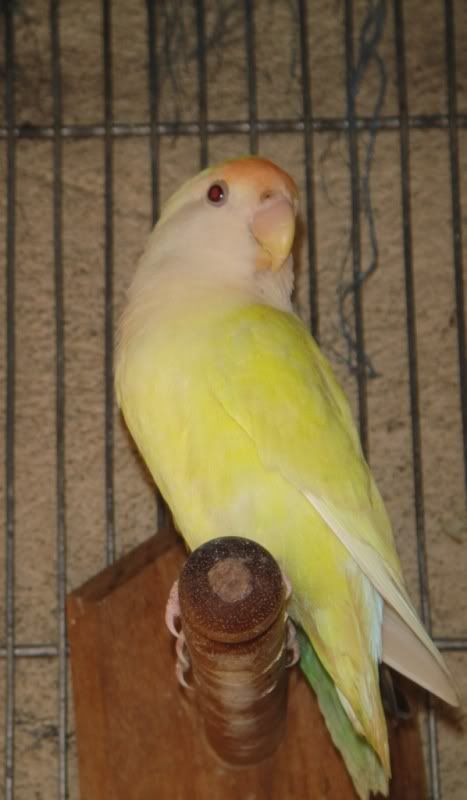
 Rosy-faces lovebird
(aka: Peach faced Lovebirds)
Rosy-faces lovebird
(aka: Peach faced Lovebirds)
*Agapornis Roseicollis
Description: 15 cm (6 in) long. Mostly green,
orange face, blue lower back and rump,
horn-coloured beak
Color in the wild: Green
Color in captivity: Yellow, green, violet, mauve, albino,
blue, pieds, and many upcoming transmutation.
Range: Namibia, South Africa, and Angola
 Black-winged Lovebird
(aka: Abyssinian Lovebird)
Black-winged Lovebird
(aka: Abyssinian Lovebird)
* Agapornis Taranta
Description: 16.5 cm (6.5 in) long. Mostly green,
red beak, some black wing feathers.
Sexual dimorphism: only the male has red on
forehead and crown, females plumage is all green
Color in the wild: Green
Range: SE Eritrea to SW Ethiopia
 Red-headed Lovebird
(aka: Red-faced Lovebirds)
*Agapornis Pullarius
Description: 15 cm (6 in) long. Mostly green with
red on upper neck and face.
Sexual dimorphism: the male has more extensive
and a darker red on face and head, and the male
has a darker red beak than the female
Color in the wild: Green
Range: Large part of central Africa
 Black-collared Lovebird
(aka: Swindern’s Lovebirds)
Black-collared Lovebird
(aka: Swindern’s Lovebirds)
*Agapornis Swindernianus
Description: 13.5 cm (5 in) long.
Mostly green, brown collar which has a black
upper margin at the back of the neck,
dark grey/black beak
Color in the wild: Green
Range: Equatorial Africa
 Madagascar Native Lovebird:
Gray-headed Lovebird
(aka: Madagascar Lovebirds)
*Agapornis Canus
Description: 13 cm (5 in) long. Mostly green with
darker green on back, pale grey beak.
Sexual dimorphism: male has a grey
upper body, neck and head.
Color in the wild: Green and darker green
Range: Madagascar
Feeding:
Feeding is the vital necessity for every creature. No food means no life, it’s as simple as that. There are some ideal feeding of lovebirds and some are just natural feeding habits.
Certain breeders spend time researching the optimal percentages involving supplements that could be provided to their own pets especially this kind of winged creatures. Oftentimes this will depend upon relative amount using amino acids, fats, vitamins, and minerals. Yet every single creature offers a unique preferred nutrition, and that this perhaps may differ from one interval to the next such as (moulting, breeding and nesting period).
Here are my own feeding techniques for my pets:
Note: For me this is the most ideal seed ratio
Seeds:
Bird seed (White millet) – 40%
Canary seed – 30%
Red millet seed – 5%
Oat growth seed -20% (especially if with chicks)
Sun flower seed – 5%
With additives like dried Chilli and egg food (especially if with chicks)
Water:
Water must be replaced every day. With fresh water and water soluble vitamins every other week.
I use water soluble vitamins for my lovebirds, sometimes it depends on what is your purpose in obtaining vitamins, and I use ferti-vit vitamins for fertility to encourage breeding. This is for mature lovebirds like 7 months old and up. I use Thunderbird Electrogen D+ for those sick looking birds, birds with cough, or if they are newly acquired birds. Or I just use Tyrovite for maintenance.
Vegetables and or Fruits:
Note: Vegetables are given every weekend. (or everyday whatever you prefer)
Pechay
Kangkong
Parsley
Carrots
Egg Food
Hard boiled white egg